
The government had breached its fiscal deficit target given in the Budget for 2017-18 in November itself, touching 112 per cent of the limit.

According to the report, the competition deficit is more pronounced in three core areas -- innovation and entrepreneurship, mobilising talent, and product and service market efficiency.

Finmin wants higher advance tax from India Inc, interim dividend from PSUs.
Govt squeezed capital expenditure, and also cut revenue expenditure, that does not go into creating assets, by 11% in H1

If receipts from disinvestment, tax buoyancy and black money scheme offset shortfall in spectrum sale, higher expenditure due to pay commission's recommendations and capital expenditure, then the government would be able to meet the target of controlling fiscal deficit at 3.5 per cent of GDP this financial year.

The government has budgeted to cut the fiscal deficit to 3.3 per cent of GDP or Rs 6.24 lakh crore in 2018-19, from 3.53 per cent in the previous financial year.

FY14 economic growth rate pegged at 4.8-5.3%, WPI inflation set to rise
Fiscal deficit fell marginally by 2.3 per cent to Rs 90,239 crore (Rs 902. 39 billion) in the first nine months of the financial year 2004-05 mainly due to higher tax mop-up.

NITI Aayog vice chairperson Rajiv Kumar tells Indivjal Dhasmana that additional funds could be generated through divestment, and that the fiscal deficit should be widened while focusing on the revenue deficit.

The RBI is fully aware that the high-cost loans and high indebtedness of the borrowers could pose financial stability risks, if not addressed by these NBFCs. Governor Shaktikanta Das has issued a stern warning, saying the RBI is closely monitoring these areas and will not hesitate to take appropriate action, if necessary, if the culprits don't opt for self-correction. Watch out for some action, soon, notes Tamal Bandyopadhyay.
Forecasting 'slippage' in budgeted revenue and fiscal deficit targets for the current financial year, the Economic Survey 2011-12 has called for financial consolidation based on structural reforms in government expenditure.

Foreign investors have injected close to Rs 33,700 crore in domestic equities in this month so far primarily due to interest rate cut in the US and resilience of the Indian market. This also marks the second highest inflow in a month in this year so far, the last one being in March, when Foreign Portfolio Investors (FPIs) infused Rs 35,100 crore, data with the depositories showed. Going ahead, the trend of FPIs buying is likely to continue in the coming days, V K Vijayakumar, Chief Investment Strategist, Geojit Financial Services, said.

The rising goods and services tax (GST) and personal income-tax collections may bolster the Narendra Modi government's ability to announce new schemes or enhance existing ones.
The fiscal deficit for the current financial year has been contained at 5.2 per cent of GDP, lower than 5.3 per cent as was targeted, Finance Minister P Chidambaram said.

India should not loosen its fiscal deficit targets in the forthcoming budget, Prime Minister Narendra Modi's top economic adviser Arvind Panagariya said.

Following are comments from economists at leading financial institutions, banks and rating agencies on the interim Budget:
Fiscal deficit, the gap between government's expenditure and revenue, stood at 4.5 per cent in FY14, lower than 4.9 per cent in FY13.

'Your decisions should not be driven by your view on the market, but by your objectives, risk appetite, and time horizon.'

The Reserve Bank of India (RBI) has identified "climate shocks" as a risk to food inflation rates and overall price rise while stating that the outlook for the country's economic growth remains bright. In its Annual Report for 2023-24, released on Thursday, the central bank said easing supply-chain pressures, broad-based softening in core inflation, and early indications of an above-normal southwest monsoon meant well for the inflation outlook in 2024-25. "The increasing incidence of climate shocks, however, imparts considerable uncertainty to the food inflation and overall inflation outlook," said the RBI while noting headline inflation moderated by 1.3 percentage points on an annual average basis to 5.4 per cent in 2023-24.

Among the Sensex firms, Larsen & Toubro, UltraTech Cement, JSW Steel, Titan, Bajaj Finance, Wipro, Tech Mahindra and Nestle were the major laggards. Maruti, Power Grid, Axis Bank, State Bank of India, NTPC, HDFC Bank, ITC and IndusInd Bank were the gainers.

Lower reduction in fiscal deficit is to stimulate demand in a weak economic environment post demonetisation.

'Investors should consider small and midcaps only if they can handle volatility and have a longer investment horizon.'

FinCom prescribes scrapping of effective revenue deficit.

The RBI under former governor Shaktikanta Das resisted pressures to cut interest rates through 2024 as it kept its 'Arjuna's eye' trained on inflation, but the central bank under a new detail-oriented head will soon have to take a call if it can continue sacrificing growth. Das, a career bureaucrat who in 2016 oversaw Prime Minister Narendra Modi's highly disruptive demonetisation move, left a lasting legacy as he demitted office towards the end of 2024 after expertly navigating monetary policy for six years, the highlight of which was steering India's recovery through the pandemic.
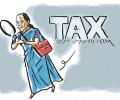
India's gross tax revenue, comprising both direct and indirect taxes between April and July, reported a growth rate of merely 2.8 per cent to Rs 8.9 trillion compared to the same period a year ago, as shown by government data on Thursday. This growth was dampened by direct tax figures, offsetting the healthy growth in goods and services tax collections and Customs duties. While net tax revenue contracted by 12.6 per cent to Rs 5.8 trillion up to July, accounting for 25 per cent of the Rs 23.3 trillion full-year target, this could be attributed to the increased tax devolution to states during the period.

While the latter is being viewed as a greater concern, the former may gain prominence in the next few weeks.

With not much hope on robust tax collections and disinvestment, economists peg the gap between the government's expenditure and receipts to be between six and seven per cent for this financial year.

Andhra Pradesh Chief Minister K Rosaiah on Saturday presented a tax-free budget for financial year 2010-11 with an outlay of Rs 1,13,675 crore (Rs 1.13 trillion) and a projected expenditure of Rs 1,13,660 crore.

Looking under the hood, I see India on the terrible, but commonplace, road to prosperity failure, warns Rathin Roy.

Arun Jaitley opted for a fiscal deficit of 3.9% in 2015-16.

The government had budgeted revenue realisation for 2012-13 fiscal at Rs 10.38 lakh crore (Rs 10.38 trillion).

On the revenue front, the finance ministry was expecting higher proceeds from non-tax revenue.
India's fiscal deficit, including the Centre and states, would be among the highest in the world and likely to be 10.3 per cent of GDP in the current fiscal and 10 per cent in the next fiscal, financial services firm Goldman Sachs said on Friday.
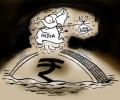
The government is committed to restricting the fiscal deficit at 4.1 per cent of the GDP during the current financial year

The GDP has been estimated at Rs 126.54 lakh-crore (Rs 126.54 trillion).

Centre shows optimism of achieving the target of 4.1% at back of recent measures and turn around in manufacturing.

Not only is the current US financial crisis not solved, the seeds are there for even more serious crises in the future, writes Deepak Lal.

The new government that presents the full Budget for 2024-2025 in July should be ready to restructure the way divestment is managed and implemented, proposes A K Bhattacharya.
During April-October 20 period, the tax department has made refunds to the tune of Rs 80,850 crore.
